Oct 24, 2026new
How to Add TPE Grid to Your Existing Mattress Without Changing Your Production Line
Learn how mattress manufacturers can add TPE Grid to existing memory foam, latex or hybrid mattresses without changing the full production line. Samples, custom layers and bulk supply.
For mattress manufacturers, developing a new premium product often raises an immediate concern:
Will we need to change our existing mattress production line?
If your factory already manufactures memory foam, latex, pocket spring or hybrid mattresses, introducing a new material can appear complicated. New machinery, new foam systems, new molds and unfamiliar assembly processes can increase development cost and slow down a product launch.
However, TPE Grid can often be introduced as an additional mattress comfort layer rather than a replacement for your existing mattress structure.
For manufacturers looking for product differentiation, this makes TPE Grid a practical material to evaluate without rebuilding the entire production system.
Start with the Mattress You Already Manufacture
The easiest development route is usually not to design a completely new mattress.
Start with an existing model that already performs well.
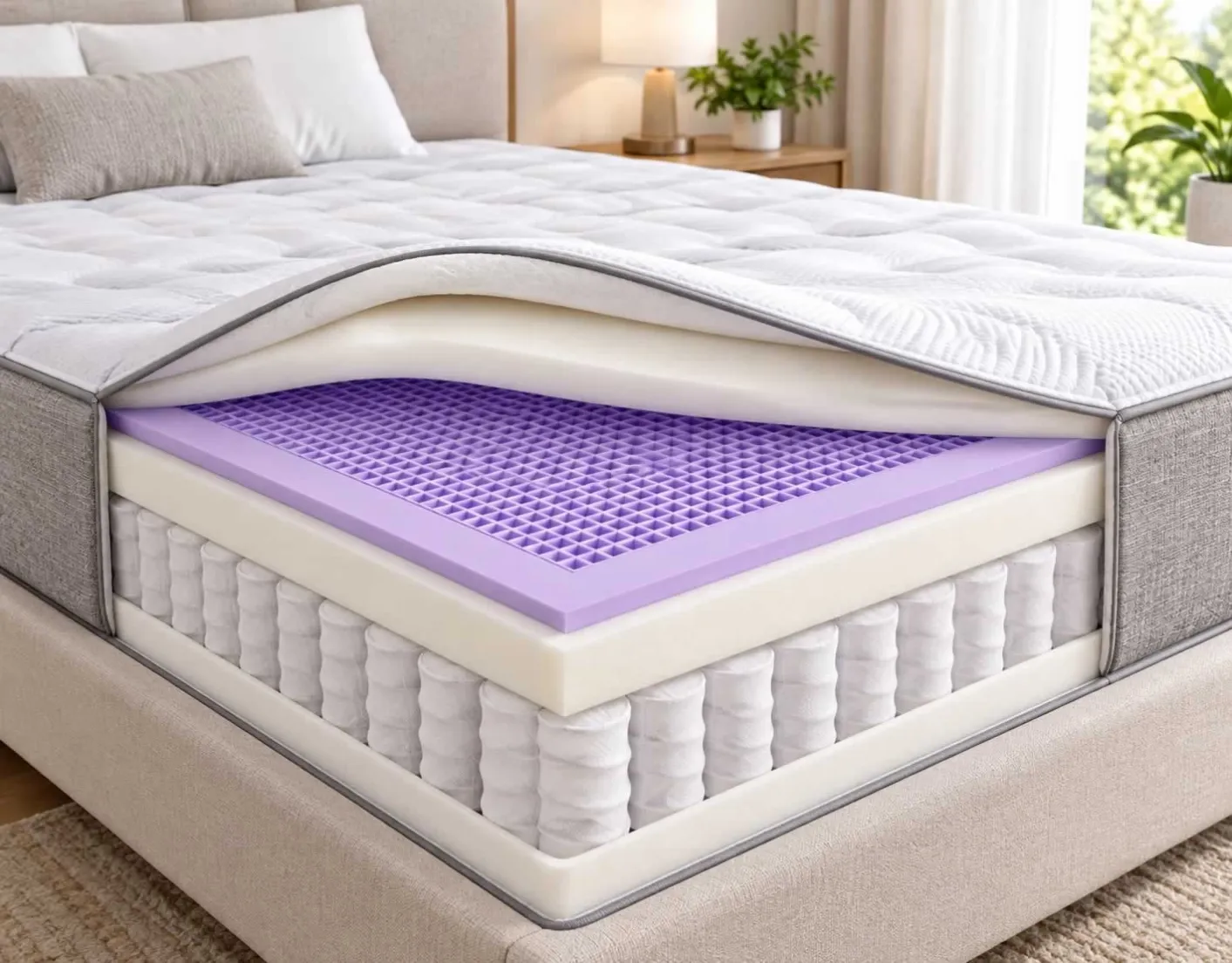
A typical hybrid construction may look like:
Mattress Cover
↓
TPE Grid Comfort Layer
↓
Existing Memory Foam / Latex / PU Foam
↓
Pocket Springs or Existing Support Core
The existing mattress continues to provide its primary support and comfort characteristics.
The TPE Grid becomes an additional upper or intermediate comfort layer.
This means manufacturers may be able to continue using their existing foam cutting, spring assembly, quilting, sewing, compression and packaging processes.
Why Add TPE Grid Instead of Replacing Foam?
Memory foam, latex and PU foam are already established materials in mattress production.
Replacing them completely may not be necessary.
TPE Grid has a different physical structure. Instead of a continuous foam surface, it uses a flexible three-dimensional grid that compresses locally under pressure and recovers when pressure is removed.
Its open structure also creates physical airflow pathways through the comfort layer.
For mattress manufacturers, the most practical strategy may therefore be:
Existing Mattress + TPE Grid = New Hybrid Mattress Collection
This allows the company to maintain familiar materials while adding a new product feature.
Can TPE Grid Be Used with Memory Foam Mattresses?
Yes.
Memory foam mattress manufacturers are one of the most relevant customer groups for TPE Grid mattress layers.
A manufacturer may keep its current memory foam system and add TPE Grid above the foam.
For example:
Stretch Cover + TPE Grid + Memory Foam + Existing Support Core
Memory foam continues to provide slow-response contouring, while the TPE Grid creates a more responsive upper surface.
This can help manufacturers develop a premium hybrid version of an existing memory foam mattress rather than replacing the original product.
Can TPE Grid Be Added to Hybrid or Pocket Spring Mattresses?
TPE Grid can also be evaluated in hybrid mattress constructions.
A hybrid mattress may already contain pocket springs, memory foam, latex and PU foam.
TPE Grid can become another comfort component within that structure.
The correct layer position depends on the mattress design.
In some projects, TPE Grid may be placed closer to the sleeping surface. In others, it may form part of a multi-layer comfort system above foam or springs.
Prototype testing is important because there is no single construction that is correct for every mattress.
What TPE Grid Thickness Should Manufacturers Start With?
Thickness is one of the first parameters to evaluate.
Common mattress-development directions include approximately 10mm, 20mm and 30mm TPE Grid layers.
A 10mm layer may work as a relatively thin comfort upgrade.
A 20mm layer gives the TPE structure a more noticeable role.
A 30mm layer can create a stronger TPE response within the overall mattress construction.
However, thicker does not automatically mean better.
The correct thickness depends on TPE hardness, grid geometry, wall thickness, foam firmness, mattress height and target comfort level.
The TPE layer should always be tested with the actual mattress underneath it.
Do You Need New Production Equipment?
In many projects, the main change is during mattress assembly rather than core production.
If the TPE Grid arrives as a finished mattress component, the factory may only need to determine how the layer should be positioned, secured and enclosed within the existing mattress structure.
Your current production line may continue handling the remaining operations.
This is particularly attractive for factories that want to test a new material without immediately investing in an entirely new manufacturing system.
Can Manufacturers Buy Only the TPE Grid Layer?
Yes.
Established mattress factories often prefer component-only supply.
The manufacturer continues producing its own foam, springs, cover and finished mattress, while the TPE supplier provides the required TPE Grid mattress layer.
This gives the mattress factory more control over the final product and allows TPE Grid to fit into its existing supply chain.
Custom projects may involve different dimensions, thicknesses, hardness levels, grid structures and colors.
Large-format mattress applications should also confirm maximum production dimensions and whether a one-piece or modular construction is appropriate.
What Should Be Tested Before Mass Production?
A TPE Grid sample should not be evaluated only by hand.
The material should be assembled into an actual mattress prototype.
Manufacturers should evaluate overall comfort, compression response, elastic recovery, compatibility with foam, finished mattress height, layer stability, cover fit and total product weight.
A practical development process is:
Existing Mattress Review → Select TPE Grid Specification → Material Sample → Mattress Prototype → Testing → Adjustment → Pilot Production → Bulk Order
This allows technical issues to be solved before they become mass-production problems.
Why This Approach Makes Commercial Sense
The biggest advantage is that manufacturers can create a new product tier while keeping the original mattress platform.
For example:
Standard Memory Foam Mattress
can remain the core product, while
TPE Grid + Memory Foam Hybrid Mattress
becomes the premium upgrade.
This gives brands and retailers a clearer product story without forcing the factory to abandon its established production capabilities.
Looking for a TPE Grid Mattress Layer Supplier?
TPE Grid Factory is a China-based manufacturer and supplier of TPE Grid mattress layers, TPE sheets and customized comfort components for international B2B customers.
We work with mattress manufacturers, memory foam mattress factories, hybrid mattress manufacturers, mattress component suppliers and product-development teams.
If you want to add TPE Grid to an existing mattress, send us your mattress dimensions, current layer structure, required TPE thickness, preferred hardness, color and estimated quantity.
We can help evaluate a suitable TPE Grid layer and start with sample testing before bulk production.